
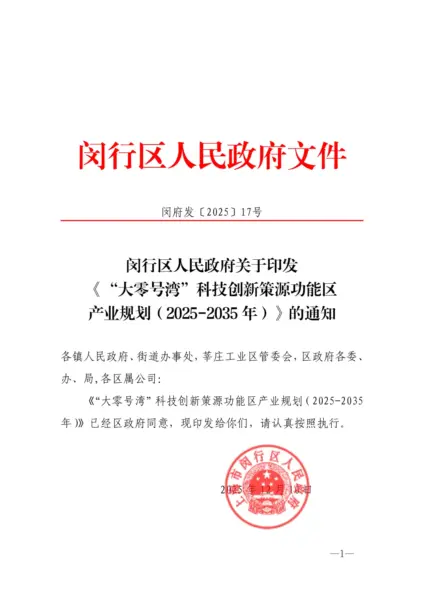
《Industrial Plan for the “Grand neoBay” Science and Technology Innovation Hub Functional Zone (2025-2035)》
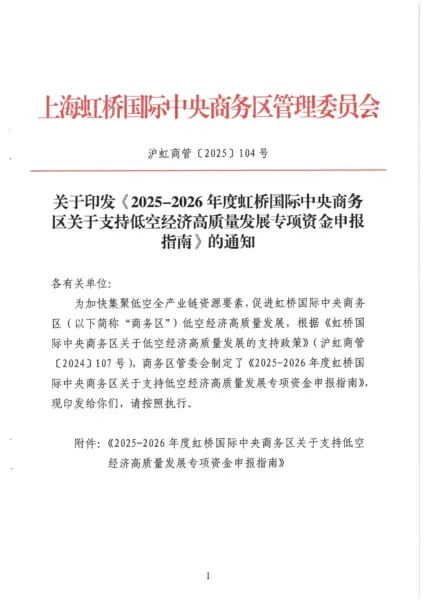
《Yangpu District Specialized, Refined, Distinctive, and Innovative SME Goose Formation Cultivation Plan—a tiered enterprise cultivation structure (2025-2027)》
《Action Plan for Reform, Innovation, and Development of the Zhangjiang Hi-Tech Park Qingpu Branch (2025-2026)》
《Requirements for Real-Name Registration and Activation of Civil Unmanned Aircraft (Draft for Comment)》
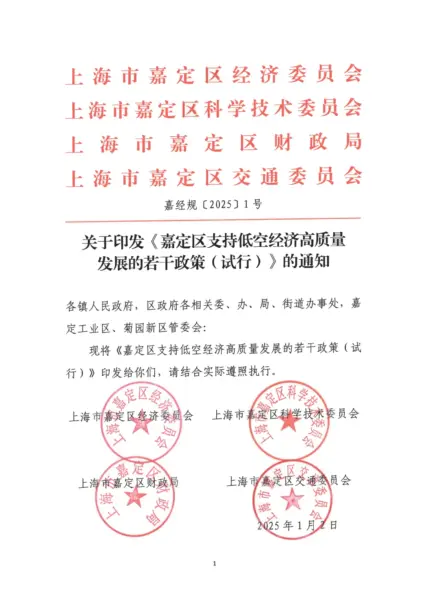
On January 12, 2025, the Notice on Issuing the “Action Plan for the High-Quality Development of the Low-Altitude Economy Industry in Qingpu District (2024–2027)” was released. The Plan states that by 2027, an industrial cluster centered on the research, development, manufacturing, headquarters economy, airworthiness certification, and commercial application of new low-altitude aircraft—including industrial-grade drones, electric vertical takeoff and landing (eVTOL) aircraft, and new energy and advanced general aviation aircraft—will be established. This cluster will foster a development pattern where low-altitude R&D and production complement each other, manufacturing and services integrate, and applications and industries mutually reinforce. It aims to become a pilot zone for smart city air traffic, driving the formation of an industrial cluster focused on low-altitude R&D and production conversion, manufacturing and service integration, and application-industry synergy. airworthiness certification, and commercial application. This initiative aims to foster an integrated development model where low-altitude R&D and production complement each other, manufacturing and services converge, and applications and industries mutually reinforce. The district will evolve into a pilot zone for smart city air traffic management, a hub for the Yangtze River Delta’s low-altitude economy industry, and a driving force for low-altitude economic operations, establishing itself as an influential comprehensive low-altitude economy industrial cluster. (People’s Government of Qingpu District, Shanghai)
1. Leading enterprises continue to expand. Develop a “1+4” specialized low-altitude economy industrial park. Attract and cultivate over five leading enterprises in industrial-grade drones, eVTOL, new energy, and advanced general aviation aircraft R&D, manufacturing, operation services, and key supporting industries to establish operations. Guide over 50 low-altitude industrial chain projects to take root in Qingpu, creating a series of landmark products. The industry will coalesce into a cohesive chain, with cumulative investment in the upstream and downstream low-altitude economy industrial chain exceeding 6 billion yuan.
2. Significant leap in industrial capacity. Focus on building an industrial structure centered on low-altitude R&D, manufacturing, testing, and headquarters economy industries, supported by low-altitude flight and support services, and featuring low-altitude innovation services alongside cultural tourism and commerce. Accelerate industrial clustering to achieve an industrial scale exceeding 20 billion yuan.
3. Infrastructure is largely in place. The launch of cross-provincial routes within the Yangtze River Delta region lays a solid foundation for establishing the area as a national hub for low-altitude interprovincial general aviation. A grid-based network of over 50 distributed takeoff and landing facilities—including landing fields and points—along with new infrastructure for communications, navigation, energy, and meteorology has been established. This forms a secure, efficient, and interconnected ground infrastructure network.
4. Diverse application scenarios. Realize over 100 low-altitude flight service applications across emerging fields such as logistics transportation, emergency rescue, passenger transport, low-altitude cultural tourism, and smart cities, establishing viable business models. Encourage enterprises in this district to pursue commercial applications within the Yangtze River Delta Ecological Green Integrated Development Demonstration Zone and nationwide.
- Innovation capabilities have significantly improved. A number of municipal-level innovation platforms have been established, with five new municipal-level or higher innovation platforms added. Efforts have been made to establish relevant institutions such as testing and inspection centers and flight training centers, continuously enhancing the comprehensive support capabilities for low-altitude flight services.
 Translation: Wu Lang